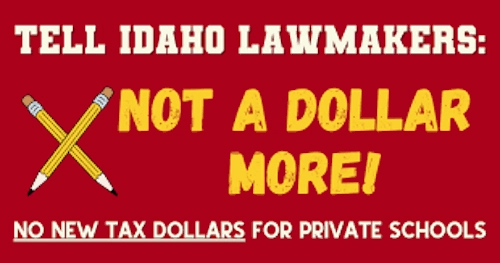
 Reclaim Idaho Executive Director Luke Mayville and members of his team stopped in Bonners Ferry tonight on behalf of Save Our Schools Idaho to tell over 20 people of work underway to fight back against blatantly unconstitutional Idaho House Bill 93, the Idaho Parental Choice Tax Credit program, part of a statewide “Not A Dollar More Act” effort to limit the impact of a disaster waiting to happen.
But there was some great news shared as well. At meeting’s end, School District 101 Superintendent Jan Bayer and School Board Vice Chair Teresa Rae announced that after five years of lobbying, of running multiple failed bond elections and gaining national media attention, local construction crews, including BF Builders, will begin work in May to replace one of the most tired and worn elementary schools in Idaho, and the new Valley View Elementary will not cost Boundary County property tax payers a dime.
“I can’t give a lot of detail, because the program is so new it doesn’t have a name yet,” Bayer said. “It’s not a bond, it’s not a loan or a grant, but we’re guaranteed a new, safe and well built school that will last for decades, covered by the state legislature.”
The news was welcome, but it did nothing to alleviate concerns about the ill-conceived, ill-considered and illegal school voucher bill, which gives parents who opt not to send their children to public school a tax credit of up to $5,000 a year for children who are homeschooled, sent to private schools, to include religious, or to any other non-public school.
Any special needs student accepted to a non-public school can claim a $7,500 tax credit.
The bill, pushed nationally for the past five years primarily by conservative and right-wing groups including wealthy donors like the Koch and DeVos families, conservative think tanks such as the Heritage Foundation and Manhattan Institute and grassroots organizations like Moms for Liberty, passed the Idaho House 70 to 61, with 19 Republicans and all nine Democrats opposed. In District 1, where all legislators are Republican, Mark Sauter voted no, Cornel Rasor voted aye.
In the Senate, it passed 35-29, with nine Republicans and all six Democrats opposed. District 1 Senator Jim Woodward voted no.
Republicans statewide who voted against HB93 saw their Freedom Foundation scores plummet.
Before he signed HB93, which sets aside $50-million in public funds, Governor Brad Little’s office was inundated with around 37,000 letters regarding the bill. Only about 5,000 favored the bill. Little signed it into law February 27, 2025.
“Just because the bill passed doesn’t mean the fight is over,” Mayville encouraged.
The “Not a Dollar More” campaign works to limit the damage by telling the legislature to cap the fund at its original $50-million as most other states that adopted voucher programs early on have seen the price tag rise drastically.
But it’s not the only effort underway to end this legislative travesty; at least two former state attorneys general are working on a lawsuit to challenge the bill’s constitutionality.
“The voucher vultures are circling the Idaho treasury, expecting to soon have government approval to gorge on money paid into the treasury by hard-working Idahoans. They want the money to be used to subsidize the private/religious education of about 36,000 Idaho kids who don’t go to public schools,” former AG Jim Jones wrote last December. “If the state subsidized the education of all of those kids at $5,000, each, it would be a $180,000,000 hit on the treasury … The voucher vultures are a collection of out-of-state, dark-money groups that want to weaken the nation’s public schools for the benefit of private/religious schooling.”
Article IX, Section 1 of the Idaho Constitution, declaring that “the stability of a republican form of government depending mainly upon the intelligence of the people,” gives the state legislature one unambiguous responsibility as regards education; to establish a system of free schools.
“It shall be the duty of the legislature of Idaho, to establish and maintain a general, uniform and thorough system of public, free common schools,” it reads.
Ratified in 1889, the legislature has yet to abide that responsibility.
Section 5 establishes further that, “Neither the legislature nor any county, city, town, township, school district, or other public corporation, shall ever make any appropriation, or pay from any public fund or moneys whatever, anything in aid of any church or sectarian or religious society, or for any sectarian or religious purpose, or to help support or sustain any school, academy, seminary, college, university or other literary or scientific institution, controlled by any church, sectarian or religious denomination whatsoever.”
“After several years and several attempts, Idaho finally has a law supporting real school choice,” sitting Idaho AG Raul Labrador wrote on February 28. “As with most all legislation, it’s not perfect, but it’s a good start for something that plays an outsized role in our state – meeting the educational needs of our kids. Education has never been effective as a one-size-fits-all approach, and our test scores reflect that, despite almost $2.5 billion dollars of taxpayer money every year sent to public schools. HB93 – now signed into law – is a step forward. This bill even received the unexpected endorsement of President Trump who said the bill had his, ‘complete and total support.’
“To no one’s surprise, there are those who oppose the idea of school choice, claiming that any public money spent on private education weakens a dismally under-performing system, and only by increasing the flow of money into the failing system can the outcomes be improved. Anyone watching the ever-growing education budgets overlaid with declining performance knows this argument is intellectually flawed.
“The weakest argument levied against Idaho’s new school choice law is that it violates Idaho’s Constitution, which prohibits public monies from being used to support religious education. This is known as the Blaine Amendment, and you will see this cited by school choice opponents regularly. Idaho is one of 37 states to have a Blaine Amendment.”
To bolster his assertion, Labrador cited the 2020 case Espinoza vs. Montana Department of Revenue.
Here are the facts of that case: “Petitioners Kendra Espinoza and others are low-income mothers who applied for scholarships to keep their children enrolled in Stillwater Christian School, in Kalispell, Montana. The Montana legislature enacted a tax-credit scholarship program in 2015 to provide a modest tax credit to individuals and businesses who donate to private, nonprofit scholarship organizations. Shortly after the program was enacted, the Montana Department of Revenue promulgated an administrative rule (Rule 1) prohibiting scholarship recipients from using their scholarships at religious schools, citing a provision of the state constitution that prohibits ‘direct or indirect’ public funding of religiously affiliated educational programs.
“Espinoza and the other mothers filed a lawsuit in state court challenging Rule 1. The court determined that the scholarship program was constitutional without Rule 1 and granted the plaintiffs’ motion for summary judgment. On appeal, the Department of Revenue argued that the program is unconstitutional without Rule 1. The Montana Supreme Court agreed with the Department and reversed the lower court.”
Prior to the adoption of HB93, Idaho did not offer vouchers or tax credits to non-public schools, in compliance with Section 5, Article IX. After, Idaho did not deny vouchers or tax credits to private schools, including religious schools, in violation.
“Idaho’s new law will probably be challenged in court by those who oppose school choice based on the misapplication of the Blaine Amendment,” Labrador wrote. “However, as your Attorney General, I will be there to vigorously defend our school choice law every step of the way.“
Besides questions of constitutionality, there are many other fundamental flaws in HB93. Non-public schools have no transparency requirements or standards of accountability whereas public schools are subject to both state and federal standards.
“If public schools are held accountable, any school that is the beneficiary of public funds should have the same requirements,” Rae said.
Public schools are required to accept and teach all students. Non-public schools aren’t. Getting a special needs or low-performing student admitted to a non-public school is as rare as finding a surgeon who’ll remove your tonsils through your armpit. Not only are the costs of teaching special needs kids astronomical; Rae said it can cost the district up to $60,000 per year to teach a special needs child and they can have 10 to 15 per year, they do little to bolster the private school’s repute, lowering the performance statistics of schools depending on attracting paying parents to enroll their progeny.
“We are not against school choice,” Bayer said, “in fact, we work with private, church and home schoolers to make sure all kids are getting a thorough education. But you must fund your choice.
The bill will have impacts far beyond the certainty of depriving funds to public schools. The cost, currently set at $50-million but not capped, will be paid through property taxes. And the costs have gone up significantly each year in every state that’s put the cost of school choice, most going not to public school students seeking an alternative but to those already enrolled in private schools, on the public.
Property taxes will almost certainly rise and public schools, obligated to provide a thorough education in free schools, will have no choice but to increase the amount of the levies they seek to make up the lost revenue.
When the bill was passed, it appeared Idaho was financially flush, with nice surpluses anticipated. Today, the state is about $80-million down, and it’s expected that over $100-more will disappear as the costs of President Donald Trump’s tariffs and reconciliation bill are realized.
With an active, statewide effort, focused on going into communities and involving public schools and the young parents who choose them for their children, Mayville said there’s a good chance Save Our Schools Idaho can limit the damage by capping HB93 at its original $50-million price tag while the battle to overturn a law passed with the sole purpose of eventually privatizing education … of turning education into indoctrination.
Those who want to fight for Idaho’s public schools can learn more at saveourschoolsidaho.com or make your voice heard and sign the petition here.