
 While we live in a world where some people curiously cheer on a White House Press Secretary answering a reporter’s question with the junior High retort of “your mom,” I figure I will drop a bit of my storytelling decorum as well and talk about me a bit. More specifically, my gear and the generality of gear in … um … general.
There is different tackle in fly fishing just like there is different tackle in all recreational fishing. On the other side of the field, there are the spin casters, bait casters, trolling rods, and the classic bobber and worm. When it comes to fly fishing, there are the typical fly rods, the longer and sensitive nymphing rods, and the even longer rods for spey casting. These, however, have specific sizes within them for different types of fishing themselves. One wouldn’t want to fish for largemouth bass with a 6’6” 3 weight fiberglass rod, and one would not want to fish small creek holes with a 9’6” 10 weight rod. One is under-powered, the other overpowered.
When someone starts to fly fish and they tell someone at a fly shop that they are mainly targeting trout in a river, they will most likely be led to the classic: a 9’ 5 weight rod. It has been the gold standard of trout fly rods for decades, and for good reason. It is a rod that casts a wide net over what you can do. It is delicate enough for presenting dry flies, long enough to euronymph (and can cast them pretty well too), and has enough of a backbone to cast out small streamers as well.
However, if the goal is small streams here in Boundary County, one cannot choose a better rod than a 6’6”-8” fly rod in 2-4 weight as they will be throwing small dry flies to fish who are easily spooked and prefer a very delicate presentation. I have two go-to rods–with many others that come out on occasion–for this type of fishing, as it is the type of fishing up here that I prefer.

First is my 6’8” S-Glass fiberglass rod from Moonlit Fly Fishing. There are mainly two types of fiberglass used in a fly rod these days. E-Glass is the classic with its insane durability and flexibility which makes it fun to use, but they are also very noodley. What this means is that there is a lot of movement of the rod during casts and not a lot of backbone. They have the accuracy, but they don’t have the power to shoot line like a graphite rod or the S-Glass variant of fiberglass fly rods. S-Glass is lighter than E-Glass, and has a bit more strength in it in terms of casting (while still not being fully competitive with a very fast action graphite rod).
The question someone might have when reading this is “why use something that is under-powered while the other exists?” or “why limit yourself in terms of a fly rod?” My response would be a simple, single word: fun. Another for me is durability, especially in the rock scrambling and slippery creek bottom type of fishing that I like to do. I have broken a few graphite rods when I was careless and a tip I wasn’t paying attention to snapped when it was pushed into the deep veins of a creekside ponderosa pine. Now, I am not going to say that it is impossible to break a fiberglass rod in the same way but I have never personally done it.
Another reason I choose fiberglass rods is the flexibility. Not only is it fun to have that surprise 14” cutthroat I found under a waterfall bend my rod to the cork but with the extra flexibility of the rod, there is extra protection for the small 6x tippets I typically have at the end of my leader on trips like these. And that Moonlit S-Glass that I have used and abused and landed many, many trout on, not much is better for the style of fishing I prefer. It also is just about the funnest stick to catch bluegill on.

As for my other go-to creek rod, I have my precious Orvis 7’11” graphite Superfine Seven-Eleven. It is a 4 wt powerhouse of a creek rod, but also just about the best rod I have ever cast. It may be graphite, but it is a bit slower than the average graphite rod with the taper that they chose (the best taper in the history of Orvis in my opinion). It packs more power than a fiberglass rod while casting like a fiberglass (or bamboo!) rod. It bends well, and it handles anything from a small sunfish to a 16” rainbow out of the Kootenai with the same finesse. The extra foot and a half it gives me over my small fiberglass rod is great for dapping flies on the surface while also having a length that works for small tight casts in the overgrowth. Anything within 50’, I can hit with precision with the stick and it does pretty well with accuracy past that too. It is a rod that can fish the creek all the way up to an alpine lake while also being strong enough to reach the middle of that alpine lake where the trout rise to the morning mayflies.
While the Seven-Eleven is a good rod for the river, in the big Kootenai here I usually want something with a bit more guts to it since, as we all know, it is a great big river. This is where I reach for my Orvis 9 for 6( 9’ rod for a 6 wt line) or my Nirvana PhoenixGlass fiberglass 5 wt that is also put out by Moonlit Fly fishing. The Orvis is a stiff flex tip that is able to shoot line far out where I need it, and has the gusto to launch dropper rigs or small to medium sized streams with ease. The PhoenixGlass is great for delicate presentation of dry flies, as a fiberglass rod usually is, and the S-Glass in it gives it a good “oomph” factor for getting out some distance. But I would be lying if those were the first rods that I reach for, or want to reach for in this situation.
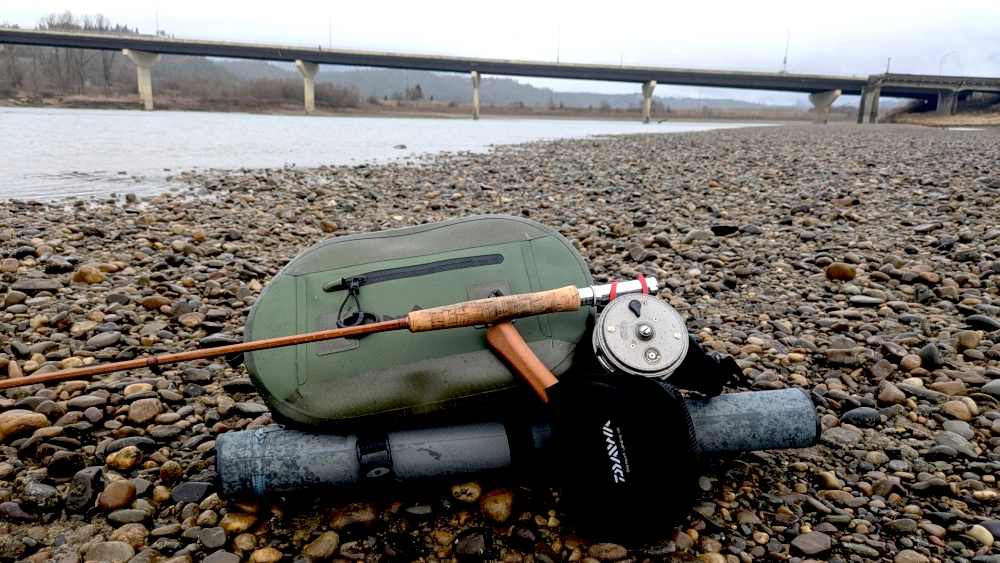
If you have been reading my column for a while, you might be able to pick up that I do like my classic tackle and that one of my prized possessions is my excellent condition pre-war Goodwin Granger Champion 8642 (8’6” 4.2 oz) bamboo fly rod made in Colorado. The Champion was their lower priced bamboo rod at that time, but it would be wholly unfair to lump it in with most blue-collar bamboo rods from that time. It was a well-built workhouse with a great taper. There is a classic quote that I will paraphrase here: Graphite is made to shoot line, bamboo is made to cast line. I can double haul a graphite rod to shoot out more line than I already have out for the long, Hail Mary type casts, but with the bamboo rod, I can accurately cast my line out within 50’ pretty well and just have a hell of a lot more fun doing it. I prefer a slower action to my rods, and getting that on a nearly 100 year rod that still holds its own with large fish gives me a satisfaction that no graphite rod will ever give me. Is it the best tool for the job? No. Is it the best tool for the job for me? Most of the time. Is it a rod that I am going to take on a drift boat with me as we fish the Kootenai? It won’t be the first rigged up, but it will be there next to me for when the right time comes along. Will I use it in the autumn to swing wet flies? Of course. Classic types of fishing demand a classic rod in my eyes. There is just a satisfaction to using tackle that was made a decade before even my father was born. And a bonus is that it was the rod that Reverend John Maclean used in “A River Runs Through It” (and in real life).
However, it would not be the rod that I would teach my wife or son to fly fish with. Bamboo requires a whole different rhythm to it that I personally feel is a bit harder to grasp than the average graphite fly rod or even the S-glass fiberglass rods. Every type of rod casts differently. I have cast rods that are ~$100 dollars that I absolutely love and still take out to this day, and I have cast rods $800 dollars or more that I have absolutely despised. It all comes down to personal preference, and if you are someone looking to get into fly fishing or a seasoned fly fisher looking for a new rod, the best advice someone could give you is to either have someone who owns many rods that you could cast and get the feel for what you like, or head down to a fly shop and test out rods there before you make a purchase. It can be intimidating–I think of myself as a pretty competent caster on my own but if I am being watched, I can look worse than I did when I was learning how to fly fish–but it is worth it so you are not stuck with a terrible rod you had only seen pictures of online with no knowledge of how it feels in your hands and how it works with your casting style.
All of this is my experience and my belief, and no one should dictate their life over the opinion of another person. Fish what you like. I know spin casters who hate bait casting. I know fly fishers who hate euronymphing (I am one of them). I know fishers who look down on a bobber and a worm but turn around to nymph river runs with an indicator. Do what you enjoy, and never let someone tell you that one way of doing something is better than the other. If I listened to that when I wanted to catch fish, I would still be slinging a rooster tail up and down the county. But I would rather be casting a Hudson Caddis along a seam and watching my fly (most of the time) while listening to the river rumble and the birds sing.
That’s fishing to me, and I know it isn’t for everyone.
And that is okay.
Do what you love, and life will be good. Do it outdoors, and it will be even better.