 Deep into autumn and on the cusp of winter in North Idaho is not my favorite time of year. It is not because of the snow as I love snow nor is it the biting chill of the northern wind as it rips through the Kootenai Valley against my exposed face while my body is warm under a sweater and a jacket.
No, the reason starts and ends with the death of dry fly season. Sure, a dimpled meniscus on a seam outside a roaring current may occasionally present hope that that same fish might rise to my small dry fly, but if I want to have the satisfaction of a tug on the end of my fly rod, I should really be using a weighted nymph at the end of my tippet.
And that really is not my style.
But I still do go out fishing, just not as often as when the snow melts and the creeks begin to feel real fishy. Yet I do still prefer to spend much of the cold time of year under the leaden winter sky rather than in the warmth and comfort of the home.
Sometimes it is active as I snowshoe through the Selkirks, take the child out sledding on the hills that I grew up sliding down, or sitting stream-side to watch the birds, make my coffee, and watch the snow falling from the boughs and sunshine dapple through the needles.
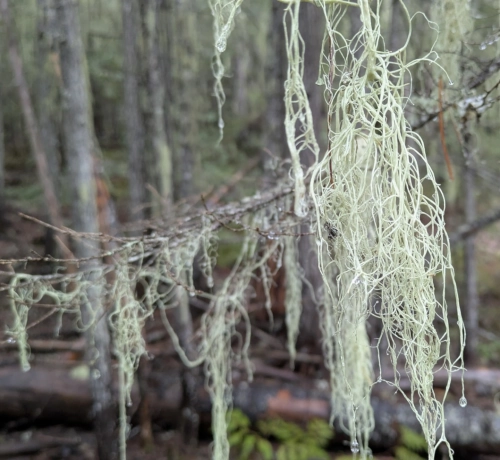
It is a much better life to live if you live it en plein air, and sometimes the rougher weather is just what you need to remember where you stand in the Anthropocene; Lilliputian and nigh non-existent outside of ourselves, our families and our community.
And that really is my style.
Weekend before last, my cousin Matt came to visit. I had not seen Matt in nearly seven years and other than a little more gray to his follicles and blue to his soul, it felt like everything picked up right where we left it. A man of great stature in the very millennial style of the jack-of-all-trades Renaissance Man, he has done everything under the sun from journalism, scuba guiding, photographer, numerous positions on television and movie film crews, to a ski guide in Japan during winters and journalist/documentarian for PBS Montana which is really, if someone asked me, his true calling.
Yet, what that means (especially since he was in the middle of working on a story in Libby when he came to visit) was that he was very much in on being a journalist and a normal conversation with him could lead to a line of questioning that I may have not been ready for, but also that I never knew I wanted to think of answers for.
To preface the conversations we had, the wild Standal is an interesting breed. There are not a lot of us in the States, and some of us started out extremely widespread from the others.
My father worked for decades with the U.S. Customs, where my immediate family went from Minnesota to North Dakota to Montana and finally to Idaho, and the rest of the family is still hunkered down back in Minnesota.
I didn’t meet anyone from outside my immediate family of six until 2015 or so when we had a family reunion on the Oregon Coast. And there are not many of us left up in North Idaho. My father passed away, nearly all my siblings live in other states, my mother lives in Coeur d’Alene now, and all that is left in the tip top of Idaho is myself.
There is an odd event that occurs when two or more of the Standal clan get together. A Proustian memory is evoked from the time we look each other in the eyes, and the talking erupts; a barrage of not-so-much playing catch up, but more so a continuation of whatever had been in discussion from the last time we met.
From the outside (bless my patient wife, but she knew what she was getting into when she agreed to marry me), it may seem like two or more people rambling on and on, a babbling brook that no beaver could dam or log could jam. Thus, our initial evening lasted until the last can was cracked and heads hit the pillow around 1 a.m.
The next morning, the sky opened up in a downpour and wouldn’t let up. We had all planned a trip up in the mountains, and everyone was accepting of the idea that we would be getting a little bit wet when we did it.
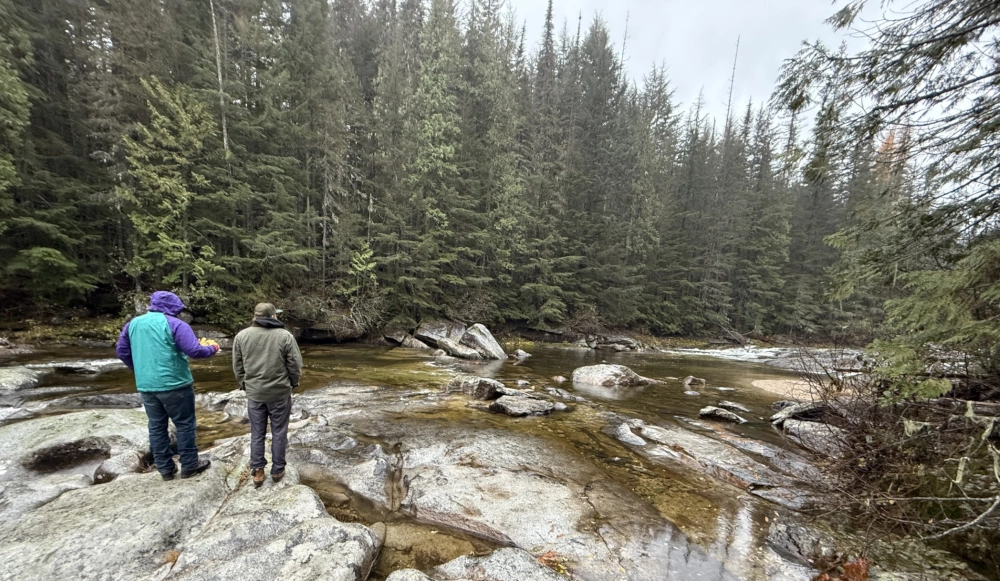
We all loaded up tightly into my vehicle and made our way up West Side Road to go up Smith Creek. Not only are there some of the most beautiful sections of creek and areas of Boundary County to enjoy but the drive is a perfect re-introduction to the Kootenai River valley for Matt, along with being a beautiful and natural piece of art for all of us to enjoy on this rainy day.
The first spot to stop on our tour was the hydroelectric dam a few miles up. While the dam is a controversial addition to the creek (and I, for one, am against it), it does make an interesting stop not only to experience the otherworldly and somewhat surreal view of such a brutalist construction with the foreground and backdrop of one of the most alluring areas in the whole county, but also that the creek below the dam is an interesting twist and turn of smooth, eroded boulders that nearly create a natural slide with no abrasion to be seen.
With the recent mountain snow and its “too early in the season” inevitable melt, the dam was pouring and the creek was pounding beneath it where it felt like the spring runoff. Much of the time spent here was silence as we watched the power of the water erupting down the rocky face with interstitial conversation about the Caribou Rainforest in which we stood.
Not that we saw a caribou, nor have I seen one in the Selkirks anywhere below the Canadian border, but one can understand where the name comes from. In the summertime, this is a great place to fish when it is not being bombarded by the copious amounts of swimmers, tanners, and wine moms that tend to soak their feet in these waters, but this time of year the fish are elsewhere. My rod remained in the car for the time being.
After delivering a bit of a history lesson and having an engaging conversation about the rainforest, we made our way back to the car and went up the road to one of my favorite fishing runs in the area.
Again, I did not rig my rod up. It didn’t feel right at the time, and that was okay. We were there to feel the power of nature around us, experience the sights and sounds, look for animal tracks in the slush that was left over from the deluge that soaked our jackets, enhanced the beauty of the north, and extended our smiles.
In the soaking mire going up the road further than we drove, we saw the tracks of an elk or two, heard the song of pine siskins, and saw a few juncos when they flew across the road after our pounding feet got close enough to make them uncomfortable.
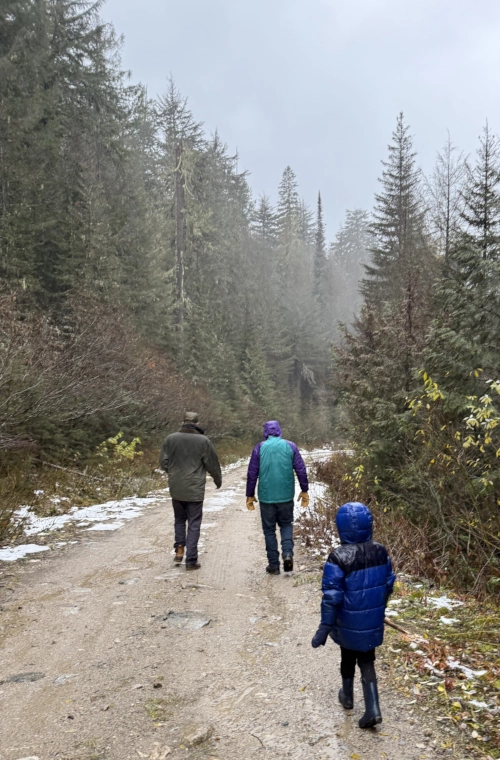
After heading up the road a bit on foot – about the time that my son would realize his jacket was soaked and that he was actually quite cold – we went back towards the car and I took Matt down to the strip of creek that I may one day call a honey hole. It is winding like much of Smith Creek, but the water flows over well-eroded sedimentary rock with a smooth creek bottom, unlike much of the creek’s small-medium river rock floor.
It provides a unique fishing experience for the native cutthroat and the non-native brook trout to where it is easier to sight fish as there is less color under the fish to help disguise them, and the small water tends to hold bigger fish than even some of the deeper pools. The curiosity and line of questioning in his journalist blood turned this moment into a learning experience as I explained trout water with all of its idiosyncrasies of specific water, intricacies, and my favorite part, the nitty gritty.
But as us Standals do, it turned into what most likely sounded like a semi-coherent ramble full of jargon, excited and expedited speech, and a lust for that intimate tug of a brook trout on a 4 weight fly rod.
However, we were all soaked and ready to go home, so the rod stayed in the car.
The next day, Matt and I woke up early and jammed into his rental truck to head to another one of those otherworldly and, this time, definitely surreal areas in Boundary County: Eileen Dam. An arch dam built in 1924 to provide power to the operations of the Cyanide Gold Mining Company, it sadly broke away from the eastern abutment that was hooked to shale in 1925 after the spring runoff in the Moyie River. What is left is a hanging concrete behemoth fifty feet tall with a large, deep pool on one side of a tall piece of shale, a smaller pool on the western side, and a great run of trout water around that shale piece.
However, while I wanted to show Matt this area and give him a history lesson (which he ate up and tried to put more pieces of the story together), I really came down for the small pool on the inside of the dam where I had successfully hooked a large trout on a caddis twice this year and lost it both times.
The third time is a charm they always say, and I had a good feeling about that day. Yet, with many great casts of the dry fly and a few with a wet fly, I had come up short. The trout had probably gone to find warmer water at the bottom of the deep pool, or it could have possibly been a brookie that was off to spawn now.
More likely, I was either unlucky or a poor fisherman that day (sometimes, those are really the same thing).
But failure turned into a casting lesson with Matt, and he had a handful of quite good casts among a buffet of very, very poor casts which is honestly better than most their first time out in my experience.
I am not a good teacher of fly casting, so to me that was the greatest success of the day. Between the fishing, we made coffee, talked about this and that – or should I say rambled – talked about the water and nature and what they mean to either of us, and continued with a familial bond that was always strong and becoming stronger, all with the backdrop of a fifty foot dam in the middle of a beautiful canyon with its roaring river, aggressive silence, and the lodgepole pines growing from the duff-filled cracks of the shale that had defeated that dam in the fight between man and nature.
We made our way back up the canyon to the truck, went back to town and parked in the driveway. We said our goodbyes, made sure Matt didn’t leave something behind, and put a pause on the rambling conversation that will surely pick up sometime in the next year or two now that he is living in Montana.
And I went back to doing my part to do whatever it is that I think I am supposed to do on this Earth, making the best of it all in the Anthropocene.